

On October 15, 2025, Chinese Ambassador to The Sultanate of Oman Lyu Jian published a signed article titled “The One-China Principle and UN General Assembly Resolution 2758” in Oman’s mainstream media Al Roya, introducing the historical context of the Taiwan question and elaborating on the One-China principle and China’s position regarding UNGA Resolution 2758. The full text is as follows:
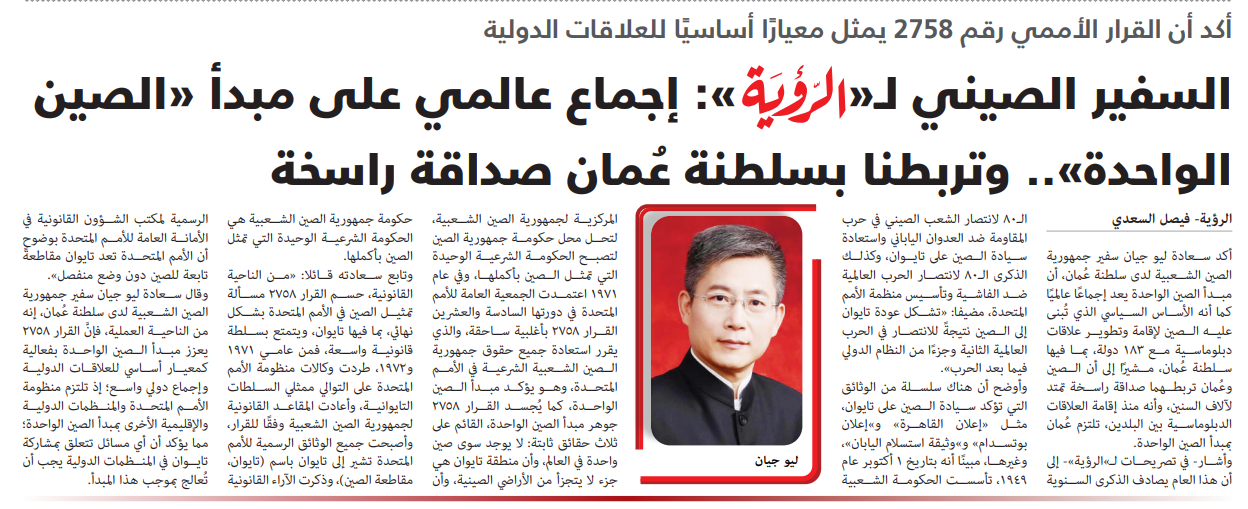
The One-China principle is a universal consensus of the international community and the political foundation for China to establish and develop diplomatic relations with 183 countries, including Oman. China and Oman have enjoyed a friendship spanning a thousand years. Since the establishment of diplomatic relations, Oman has always adhered to the One-China principle, for which China expresses its appreciation.
This year marks the 80th anniversary of the victory of the Chinese People’s War of Resistance Against Japanese Aggression and the restoration of Taiwan to China, as well as the 80th anniversary of the victory of the World Anti-Fascist War and the founding of the United Nations. Taiwan’s return to China is an important component of the outcomes of the victory in World War II and the post-war international order. A series of documents, including the Cairo Declaration, the the Potsdam Proclamation, and the Japanese Instrument of Surrender, confirmed China’s sovereignty over Taiwan.
On October 1, 1949, the Central People’s Government of the People’s Republic of China was founded, replacing the government of the Republic of China as the sole legal government representing the whole of China. In 1971, at its 26th Session, the UN General Assembly adopted Resolution 2758 by an overwhelming majority, restoring all the lawful rights of the People’s Republic of China in the United Nations. This resolution solemnly and fully embodies the One-China principle—that there is but one China in the world, that Taiwan is an inalienable part of China’s territory, and that the Government of the People’s Republic of China is the sole legal government representing the whole of China.
From a legal perspective, UNGA Resolution 2758 completely resolved the issue of China’s representation, including that of Taiwan, in the United Nations, and carries broad and authoritative legal force. Between 1971 and 1972, agencies throughout the UN system, acting on the basis of this resolution, expelled the so-called “representatives” of the Taiwan authorities and restored the lawful seat of the People’s Republic of China. In official UN documents, the only term used for Taiwan is “Taiwan, Province of China.” Legal opinions issued by the UN Secretariat have also emphasized that “Taiwan, as a province of China, has no independent status.”
From a practical perspective, UNGA Resolution 2758 has powerfully promoted the One-China principle as a fundamental norm governing international relations and a broad consensus of the international community. The United Nations system, as well as other international and regional organizations, all adhere to the One-China principle, making it clear that any issue regarding the participation of the Taiwan region in the activities of international organizations must be handled in accordance with the One-China principle.